The Unwritten Trade
What is the true trade you are making by employing AI?
For three years the question has been whether AI takes jobs. Stanford’s economists went looking in payroll data through the middle of this year, and their answer is no. There is no widespread, economy-wide displacement. That is the finding, it comes from the most careful look anyone has taken at the question, and it is good news. Take it as good news.
Something else happened in the same window. It is smaller, quieter, and much harder to reverse. Fewer people were hired, and specifically the people who would have spent the next decade becoming experienced.
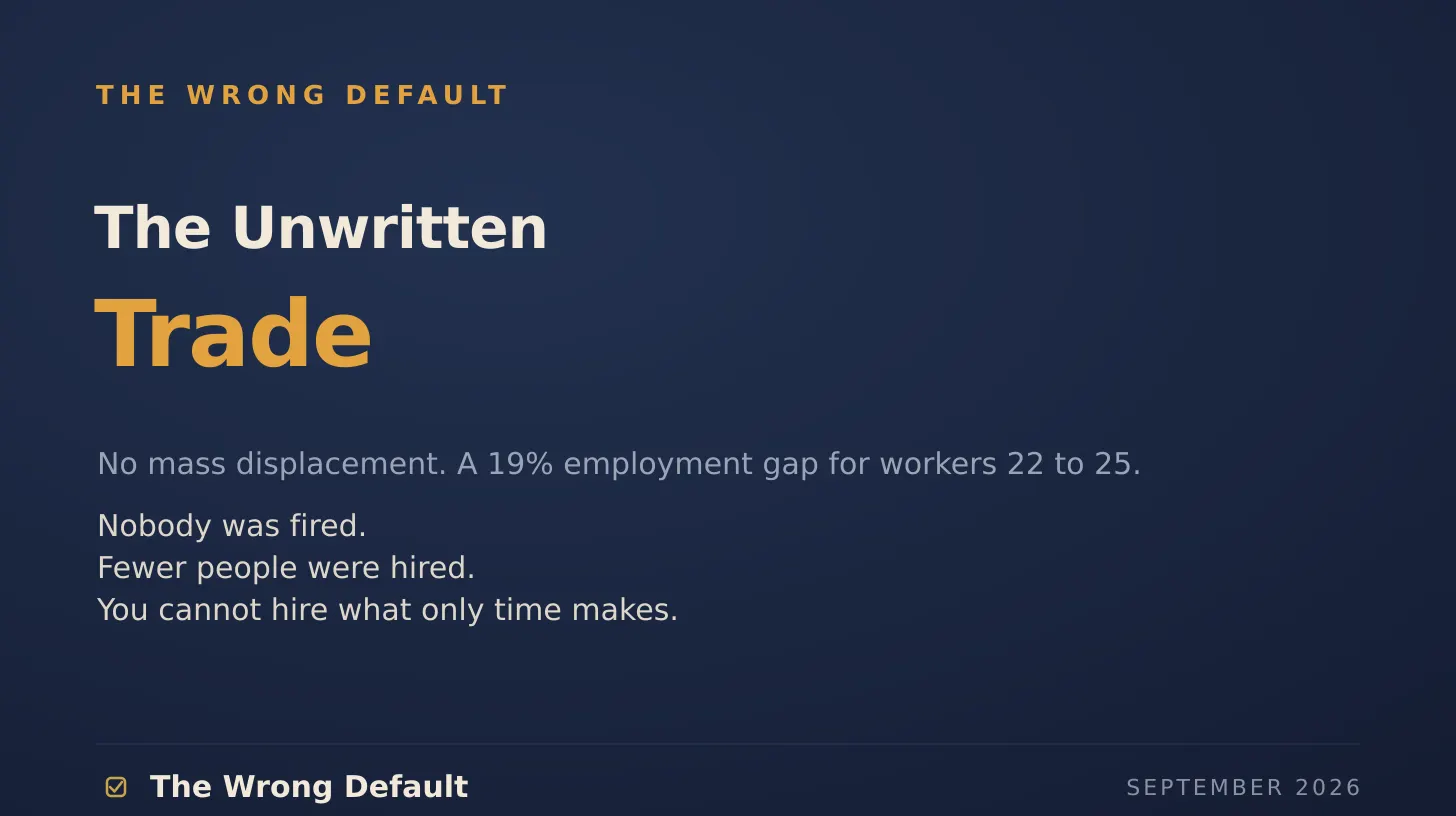
Nobody was fired. Fewer people were hired.
The Stanford Digital Economy Lab published a revision of “Canaries in the Coal Mine?” on August 12, based on ADP payroll data through June 2026. Employment among workers ages 22 to 25 in highly AI-exposed occupations now sits about 19% below where it would be if it had kept pace with similarly aged workers in less-exposed occupations. Experienced workers show no comparable gap.
This gap is widening. By that same measure the shortfall was 15% at the July 2025 data vintage and 19% as of June 2026. In plain levels, employment of 22 to 25 year olds in the two most exposed quintiles fell about 11% between November 2022 and June 2026, while the same age group in the three least-exposed quintiles grew about 10%.
The issue that matters most is not the number. It is the mechanism. The adjustment, they write, “appears to operate primarily through reduced hiring of young workers rather than increased separations.”
Read that as an operator and not as an economist. No layoff was announced. No plan was approved. No memo went out. Instead, a requisition did not get opened. And then another one did not, and another. The ones that did get opened asked for somebody who already had five years. Every one of those calls was individually defensible, made by a good manager under a real budget. Together they add up to a decision nobody made.
Administrative data says the same thing from a different direction. A Census Bureau working paper from April, by Lee C. Tucker, using matched employer-employee records, finds an immediate, sizable and persistent drop in early-career hires in the industries most exposed to AI after ChatGPT’s release, and states that “the decline in hires is the primary cause of large observed declines in employment over the subsequent period.” Different dataset, different unit of measurement, same mechanism.
A third look arrived in September, and it reaches well past the United States. Bharat Chandar of Stanford and Bouke Klein Teeselink of King’s College London followed firms in 41 countries through LinkedIn and job-board data. At companies adopting AI, senior employment rose 6.7% while junior employment fell about 2.5%, and the junior share of the workforce dropped roughly two percentage points in about three quarters of those countries. Chandar notes that the sample leans toward digitally connected multinational firms. The firms grew. The growth went to experience.
Two serious studies that disagree
Two weeks before the Stanford revision, Apollo’s chief economist Torsten Slok and Sania Edlich published a paper on the same question and came out somewhere else.
Their result: workers in high-exposure occupations saw real wages grow about 6.7 percentage points more slowly than workers in low-exposure occupations after 2023, with no detectable employment effect. Their reading is that firms are capturing AI productivity gains through wage compression rather than workforce reduction. The effect is concentrated at the bottom, around 10.7% in the lowest wage quartile against no significant effect in the top.
Stanford’s sixth fact says close to the opposite. “So far, adjustment is showing up primarily in employment rather than base pay.”
Two credible sources, two weeks apart, pointing different directions on the same question. I am not going to resolve that for you, and I would be careful with anyone who does. The honest reasons they differ are sitting in the papers themselves. Different data, ADP payroll against federal wage statistics. Different windows, Stanford running through June 2026 while Apollo’s post-period ends in 2025.
Here is what survives the disagreement, and it is the whole reason this edition exists. Whether the adjustment landed on headcount or on pay, both papers describe the same event: an organization captured a productivity gain through a channel nobody designed, nobody announced, and nobody signed. They disagree about which channel. Neither one found anybody who owned the decision.
What the market just repriced
Stanford’s fifth fact splits the difference by how AI is actually being used. The employment declines concentrate in occupations where AI usage automates human tasks. Where AI is used to complement people, “employment is flat or rising, particularly among more experienced workers.”
The revision goes one layer down, and this is the finding that makes the whole thing legible. Employment fell among young workers in occupations that lean on codified knowledge, which they define as “formal, standardized, documented knowledge that can be taught through education, textbooks, or written procedures.” Employment rose among experienced workers in occupations that lean on tacit knowledge, “acquired through practice, mentorship, and repeated exposure to real situations.”
So the same technology moved two numbers in opposite directions. It made codified knowledge cheaper to obtain and formed judgment more valuable to hold. If you have twenty or thirty years in a field, the data says your value is appreciating, and the reason is not seniority. It is that what you know was never written down anywhere a model could read it.
Neil deGrasse Tyson put it more plainly than either paper. Asked on Mythical’s Last Meals about looking things up now that search hands him an AI answer, he said it is right about 85 percent of the time and wrong the other 15. “I only know that,” he said, “because I know what it is I’m looking up.” For everyone else, “it’s just the answer.” The 15 percent is visible only to someone who already knows. That is tacit knowledge doing its job, and it forms only in the years a requisition pays for.
The one thing you cannot buy back
Every other mistake in an AI rollout is recoverable with money. Wrong vendor, switch. Overbought compute, unwind it. Too many seats, cut them. Bad architecture, rebuild it. All of that is painful and all of it is reversible, because all of it was a purchase.
The judgment that tells you the model is wrong is not a purchase. It is grown, by putting a person next to real situations for years, and that clock runs at one speed no matter what the budget says. You cannot hire what only time makes.
Which is the trade. Cheaper capability now, against thinner judgment later. It is a real trade, it was made at scale across the economy, and it appears in no board paper, no strategy document, and under nobody’s name. Call it the unwritten trade. The organizations that made it are not reckless; they were making sensible calls one requisition at a time, which is exactly how the largest decisions get made without anyone deciding them.
There is a symmetry here worth one sentence and no more. At the start of a career the risk is that judgment never forms. At scale the risk is that the organizations quietly stop funding the years in which that is possible.
What this argument does not prove
The Stanford authors are careful, and the care is load-bearing, so it belongs here and not in a footnote. They call these “descriptive patterns, not causal estimates of the effect of AI.” The gaps between more- and less-exposed young workers shrink when education is accounted for. Some differential trends are visible before generative AI was in wide use. The estimated gaps are larger in the ADP sample than in national survey benchmarks. They say plainly that they do not view this paper, or any single study, as definitive. Tucker’s Census paper carries its own caution, that up to a quarter of the employment decline through mid-2025 may be attributable to monetary policy shocks, though it does not find that those shocks explain the drop in hiring.
Nobody has proven AI caused this. That is the state of the evidence and it should be stated that way.
The argument does not need causation. Strip the cause out entirely and the thing on the table is unchanged: the mix of experience your organization hired shifted over three years, that shift has a longer tail than any purchase on the AI line, and almost nobody can say who decided it. If the answer is that it emerged, then it was not a strategy. It was the default.
So own it
The AI decision your organization documented is the purchase. There is a business case behind it, a vendor, an owner, probably a steering committee. The decision it did not document is the hiring mix, and that is the one with the ten-year tail.
Before the next budget, somebody should be able to answer two questions. What did our hiring mix do over the last three years, and who decided that. Both are free to ask. Both have real answers sitting in a system you already pay for. And they belong on the same ledger as the AI spend, just on a page nobody has opened yet.
From me, and yes, I’m still selling something. The Consigliere is open. Written guidance for using AI at work, for your field and your role: what belongs in the system, what never goes in, and which decisions are still yours. Not another intelligence. A way to deepen your own. $225 for a year, nothing renews. Buy before the end of 2026 and access runs through December 31, 2027. theaiconsigliere.com.
Sources
Stanford Digital Economy Lab: https://digitaleconomy.stanford.edu/news/canariesaug26/ Page title: “No Widespread Displacement, but the AI Employment Gap for Young Workers Has Widened to 19%” Published August 12, 2026, last modified August 17, 2026. Authors of the underlying paper: Erik Brynjolfsson, Bharat Chandar, Ruyu Chen. Data: ADP payroll, through June 2026.
Apollo Global Management: https://www.apollo.com/wealth/insights-news/insights/daily-spark/ai-lowers-wages-but-doesnt-cut-jobs Title: “The Impact of AI on the U.S. Labor Market.” Authors: Sania Edlich and Torsten Slok. Published July 30, 2026.
U.S. Census Bureau, Center for Economic Studies: https://www.census.gov/library/working-papers/2026/adrm/CES-WP-26-27.html Title: “You’re (not) Hired: Artificial Intelligence and Early Career Hiring in the Quarterly Workforce Indicators.” Author: Lee C. Tucker. Working paper CES-26-27, April 2026. Page last revised May 7, 2026.
Chandar and Klein Teeselink: https://bharatchandar.substack.com/p/ais-impacts-on-jobs-around-the-world (author’s summary, September 21, 2026). Paper: https://papers.ssrn.com/sol3/papers.cfm?abstract_id=7498743
Neil deGrasse Tyson, via Still In Charge: https://stillincharge.org/neil-degrasse-tyson-other-15 (June 21, 2026). Interview below.
 Watch on YouTube ↗