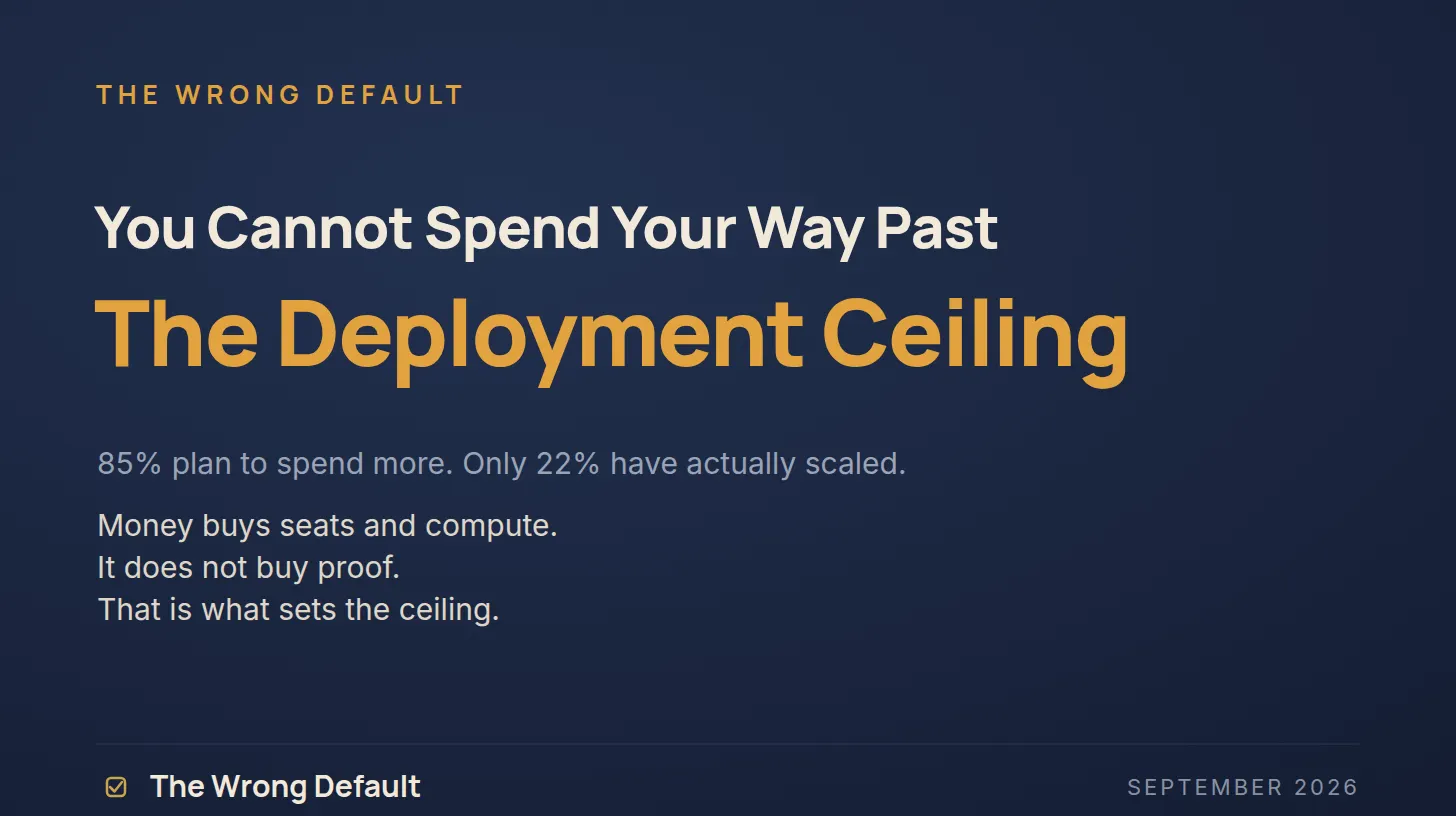
You Cannot Spend Your Way Past the Deployment Ceiling
Money buys seats and compute. It does not buy proof. That is what sets the ceiling.
Every leader already knows the fix when AI is not producing enough yet: spend more. Another seat, more compute, one more integration, a second vendor. It is the one move everybody already knows how to make, and for a while it actually works. Then it stops working, and almost nobody notices the moment it happened.
The number that does not move with the spending
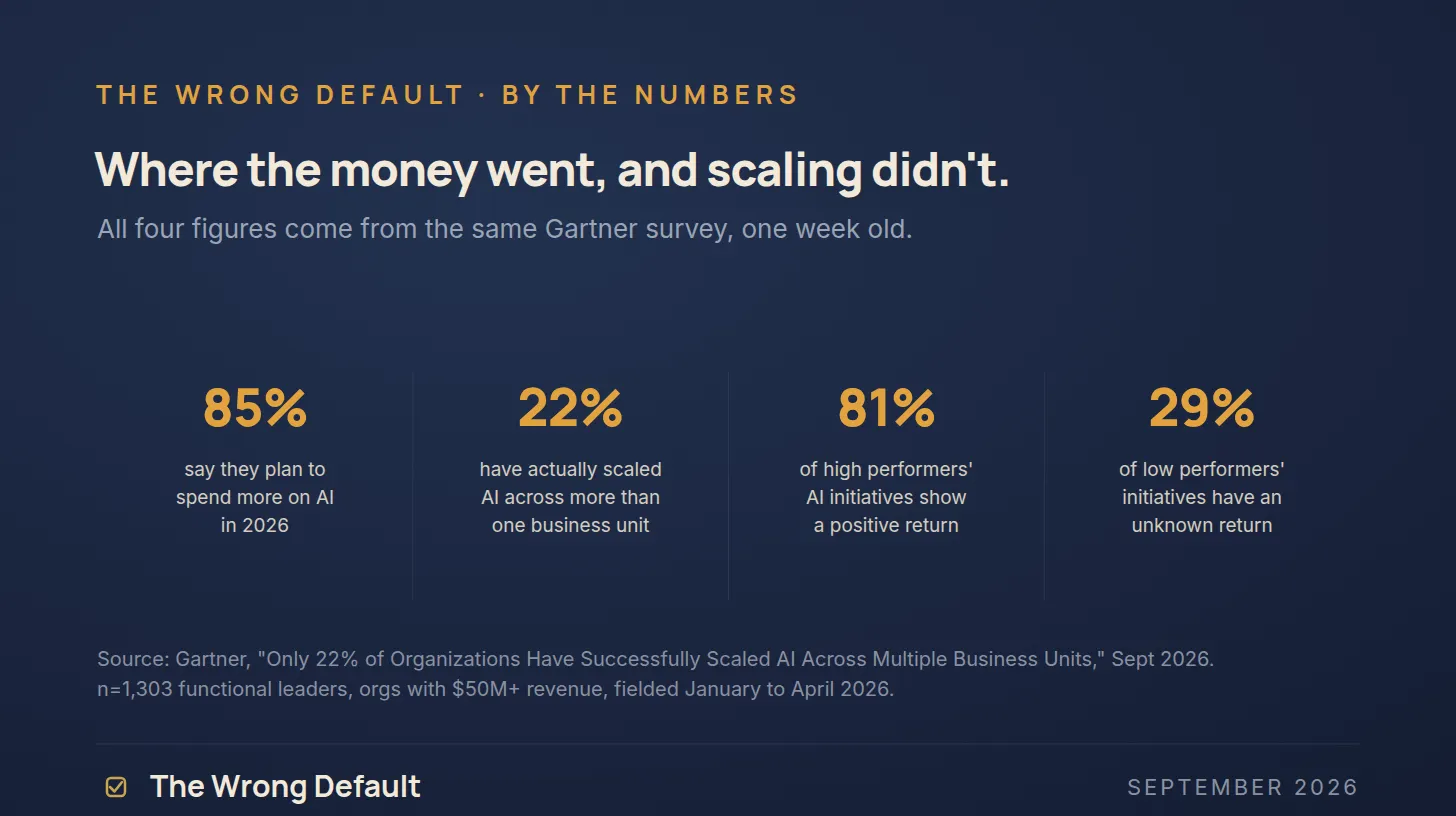
Gartner surveyed 1,303 functional leaders this year, at organizations with at least $50 million in annual revenue, between January and April. Eighty-five percent said they plan to spend more on AI in 2026. The average organization had already put 12% of its functional budget behind it in 2025. Eleven percent could not even say what their function spent on AI last year, and that is with the number rising.
So the money is not the problem. The money is already there, and more of it is coming.
Only 22% of those same organizations have actually scaled AI across more than one business unit. Everyone else is still running it in pockets: a team here, a pilot there, a use case that worked once and never left the department that built it. That is the gap. Spending went up across the board. Scaling did not follow it.
What actually separates the 22%
It is tempting to assume the 22% simply spent more, or spent smarter, or picked better software. Gartner’s own numbers say otherwise. The organizations it calls high performers report positive returns on 81% of their AI initiatives. The low performers cannot even say what the return was on 29% of theirs. That is not a gap in ambition, and it is not a gap in budget. It is a gap in whether anyone can prove what happened after the money went in.
Gartner’s Tina Nunno put the mechanism plainly: “Without disciplined measurement tied directly to business outcomes, organizations risk wasted resources and unmet expectations.” Read that twice. An analyst firm just said, in its own press release, that the thing separating the scaled from the stuck is measurement, not money.
Zoom out and the shape gets starker. Gartner also puts total worldwide AI spending at $2.59 trillion this year, up 47% from 2025, with more than half of it going into infrastructure alone. That much capital is now chasing a result that only 22% of buyers can show they are actually getting. More dollars are not closing that gap. They are making it more expensive to keep ignoring.
The market is starting to notice
The org chart is usually the last place to notice a ceiling. The money notices first. Forrester’s 2026 predictions call for enterprises to defer a quarter of their planned AI spend into 2027, on the reasoning that financial scrutiny is rising faster than proof is arriving. That is a forecast, not a settled fact, and it is worth treating it as one. But it is a forecast built on the same gap described above: by Forrester’s own account, fewer than a third of decision-makers can currently tie their AI spending to financial growth. CFOs are starting to ask the question the vendor was never going to ask for them.
Governance was sold as the wrong kind of purchase
Governance usually gets bought like insurance: a policy against something going wrong, priced against a risk that still feels distant, and every insurance purchase is deferrable right up until the day it is not. Sold that way, governance competes for the same budget as the tool itself, and it mostly loses, because the tool comes with a demo and the policy comes with a premium and no visible payoff.

That framing has it backwards. Governance, meaning who owns which decision, what gets checked before it ships, what gets logged, and what escalates and to whom, is not a hedge against the AI. It is the thing that lets you put more of it to work. Money buys seats and compute. It does not buy the answer to the one question every regulator, insurer, board member, and customer eventually asks: how was this decision made, and who is accountable for it. That answer is proof, not spend, and proof is exactly what separates the 22% from everyone standing next to them holding a bigger invoice.
The ceiling has a name
Call it the deployment ceiling. It is not set by the budget. It is set by what you can prove. Spend past it and the extra dollars do not raise the ceiling at all. They just crowd more use cases underneath one that was never going to move on its own.
None of this is a technology failure, and it is not one department’s fault either. It is a sequencing mistake, and it is sitting inside nearly every organization in that 78%: governance gets tacked on at the end of the rollout instead of built in before it. The fix costs nothing to start. Before the next dollar goes into AI, somebody has to be able to answer who owns this decision and how we would prove it if asked. That question is free to ask. It is also the only one that actually moves the ceiling.
Call it governance because that is the word that gets budget approved. What it actually is, is strategy. A plan that does not assign ownership or define what proof looks like is not a strategy, it is a hope with a budget attached.
Where to start. The free Decision Ownership Check asks where the decisions around your AI actually sit and gives you a score at the end. Takes a few minutes. No contact details needed to see the result. fellowshipintelligence.com/decision-ownership-check
Sources
- Gartner, “Gartner Survey Finds Only 22% of Organizations Have Successfully Scaled AI Across Multiple Business Units,” published 1-2 September 2026. https://www.gartner.com/en/newsroom/press-releases/gartner-survey-finds-only-22-percent-of-organizations-have-successfully-scaled-ai-across-multiple-business-units
- Gartner, “Gartner Forecasts Worldwide AI Spending to Grow 47% in 2026,” published 19 May 2026. https://www.gartner.com/en/newsroom/press-releases/2026-05-19-gartner-forecasts-worldwide-ai-spending-to-grow-47-percent-in-2026
- Forrester, “Forrester’s 2026 Technology & Security Predictions: As AI’s Hype Fades, Enterprises Will Defer 25% of Planned AI Spend to 2027,” published 28 October 2025. https://investor.forrester.com/news-releases/news-release-details/forresters-2026-technology-security-predictions-ais-hype-fades-0