The Sentence With No One in It
When a decision goes wrong, the person who made it is often the first thing to disappear. They disappear from the sentence before they disappear from anything else.
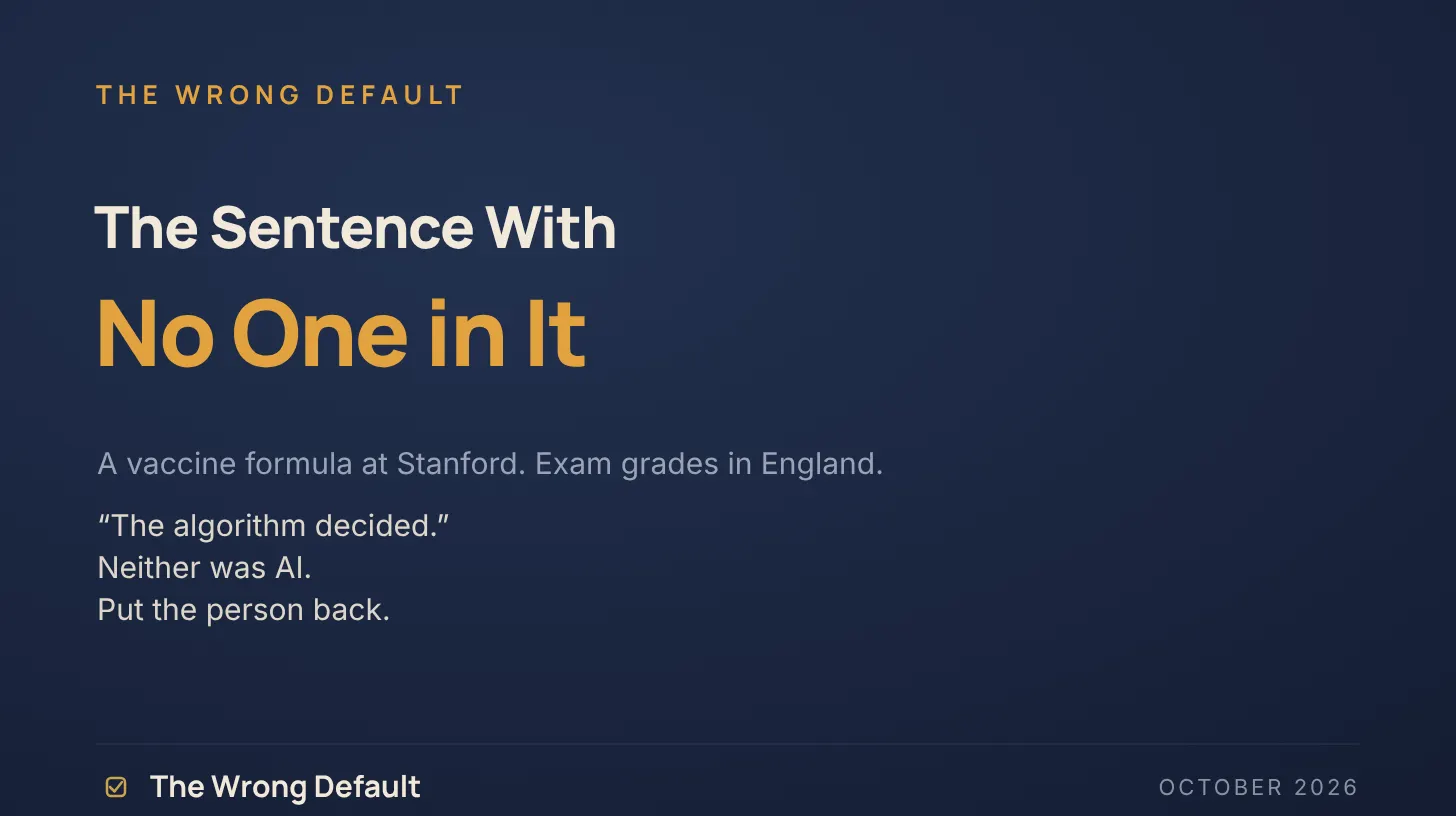
Listen to how people talk about AI at work. “The AI flagged it.” “The model decided.” “The system approved it.”
Each of those sentences sounds accurate enough. Each also does something nobody voted on. It takes a decision a person made, or a person signed off on, and moves it to a tool. No policy changed. No role was reassigned. The sentence did it.
Call it the sentence with no one in it. It is one of the oldest defaults in how organizations talk about their own decisions, and it is older than AI.
Seven of thirteen hundred
In December 2020, Stanford Medicine received its first 5,000 doses of the COVID-19 vaccine. Of more than 1,300 resident physicians, the young doctors working on the front lines, seven were on the list.
When residents protested on December 18, the first explanation was the formula. MIT Technology Review reported that hospital leadership apologized and blamed the errors on “a very complex algorithm.” One official told the residents: “Our algorithm, that the ethicists, infectious disease experts worked on for weeks … clearly didn’t work right.”
The algorithm was not AI. MIT Technology Review found it was a points system built on three categories: employee age, job-based variables, and state public health guidelines. Residents said it did not account for exposure to COVID-19 patients, and they were told they had lost out because they rotate between departments rather than hold a single assignment. People chose those categories. People set the weights. People reviewed the list. One resident wrote, in words NPR quoted, that “algorithms are made by people and the results ... were reviewed multiple times by people.”
A mutant algorithm
Four months earlier, England had its own version. Exams were canceled during the pandemic, so grades had to be estimated. The exam regulator, Ofqual, used a statistical model to adjust the grades teachers predicted. On results day, August 13, 2020, 39.1 percent of A-level grades in England came back at least one grade lower than teachers had predicted. That was about 280,000 entries.
Four days later the government dropped the model and went with the teachers’ grades. Ofqual’s chief regulator resigned on August 25. The next day the prime minister visited a school in Leicestershire and told the students their grades “were almost derailed by a mutant algorithm.”
A mutant changes on its own. The model did not. It applied the method it was given.
The sentence comes first
Neither of these was an AI system, and that is the point. The sentence was ready before the technology. If “the algorithm decided” was easy to say about a points formula in 2020, it is far easier to say about a system whose reasoning nobody in the room can read.
And the sentence does real work. Once the decision belongs to the tool, the question changes. Instead of “who chose to leave patient exposure out of the formula?” people ask “what went wrong with the algorithm?” The first question has someone to answer it. The second does not.
That is how a default forms. Organizations rarely decide to hand accountability to a tool. They describe it that way, one sentence at a time, until the description becomes the arrangement.
The second sentence
Here is the part worth noticing. Stanford’s leadership did not stop at the formula. In an email to staff the same day, they wrote: “We take complete responsibility and profusely apologize to all of you.” They said they were working “to address the flaws in our plan.” Our plan, not the algorithm’s output.
That second sentence had people in it, and it is the one that let the fix start. England reversed course within four days as well. You cannot correct a decision that belongs to no one.
Put the person back
Try this at your desk this week. In the next report, email or policy that mentions AI, find every sentence where a tool decides, approves, flags, recommends or rejects something. Rewrite each one with a person or a role in it.
“The system approved the claim” becomes “The claims team approved it, based on the system’s score.”
“The AI flagged the account” becomes “Our fraud rule, set by the risk team, flagged the account.”
The facts do not change. The owner does. The most useful result is the sentence you cannot rewrite, because you do not know who decided. That is a decision nobody has claimed yet, and it is better to find it now than on the day it goes wrong.
Then, before you rely on an AI answer for anything that matters, ask three questions:
1. What did I ask it to confirm?
2. What would make this wrong?
3. Who answers if it is?
So own it
The systems will keep getting harder to see inside. The sentence will keep getting easier to say. Every organization using AI will produce sentences with no one in them. The ones that govern well will notice, and put someone back.
If you want a quick read on where your own organization stands, the free Decision Ownership Check takes about two minutes: ten questions and an AI Governance Exposure score from 0 to 100. It is a directional read, not a validated diagnostic. fellowshipintelligence.com/decision-ownership-check
Sources
MIT Technology Review, “This is the Stanford vaccine algorithm that left out frontline doctors,” December 21, 2020: https://www.technologyreview.com/2020/12/21/1015303/stanford-vaccine-algorithm/
NPR (via KUNC), “Stanford Apologizes After Vaccine Allocation Leaves Out Nearly All Medical Residents,” December 18, 2020: https://www.kunc.org/npr-news/2020-12-18/stanford-apologizes-after-vaccine-allocation-leaves-out-nearly-all-medical-residents
Express & Star (PA Media), “From ‘mutant algorithms’ to resignations: a timeline of the exam grading fiasco,” 2020: https://www.expressandstar.com/uk-news/from-mutant-algorithms-to-resignations-a-timeline-of-the-exam-grading-fiasco-6023621
PoliticsHome, “Boris Johnson claims A-level and GCSE results crisis was caused by a ‘mutant algorithm’,” August 26, 2020: https://www.politicshome.com/news/article/boris-johnson-claims-alevel-and-gcse-results-crisis-was-caused-by-a-mutant-algorithm