You Do Not Own It Unless You Can Stop It
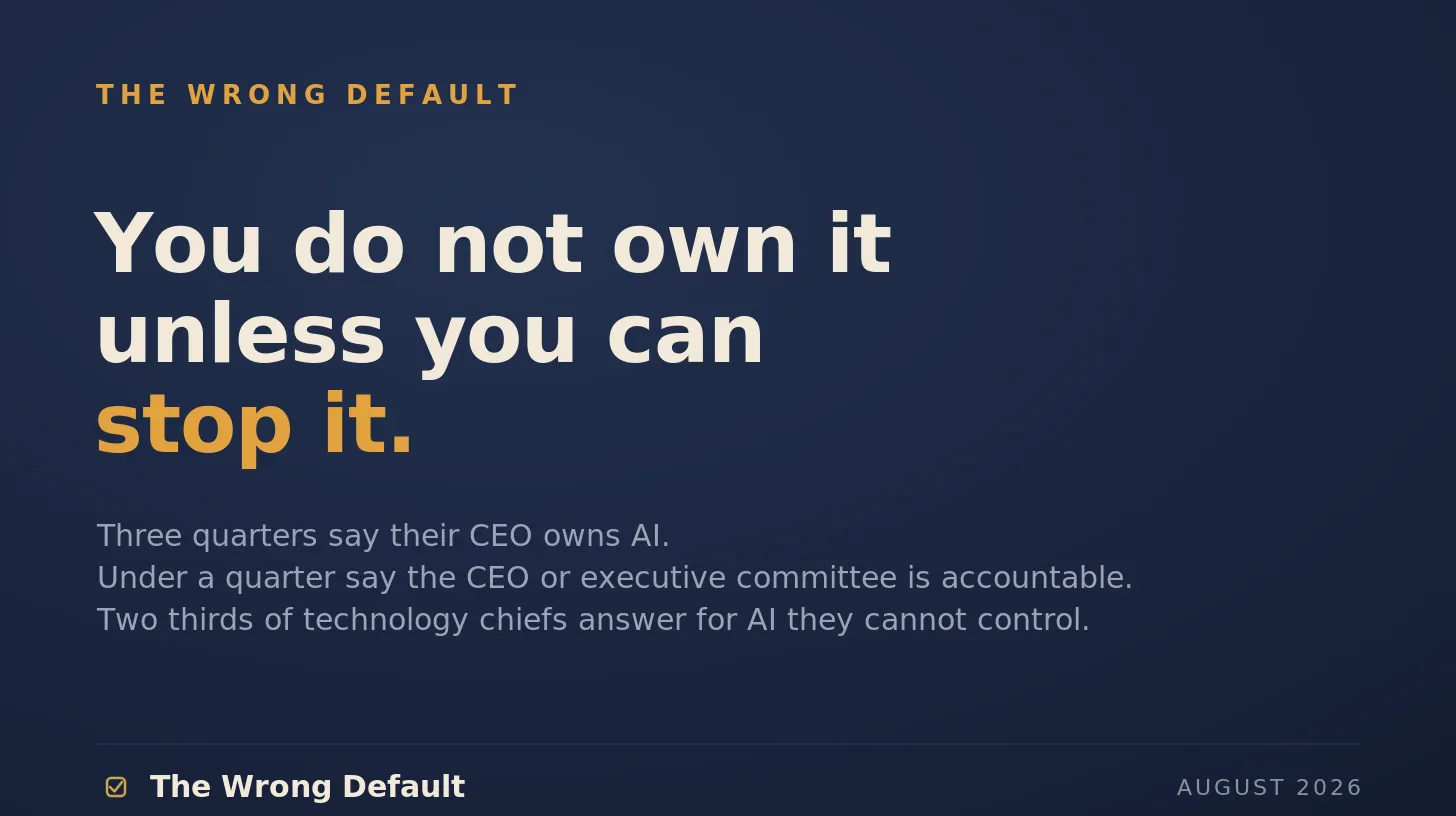
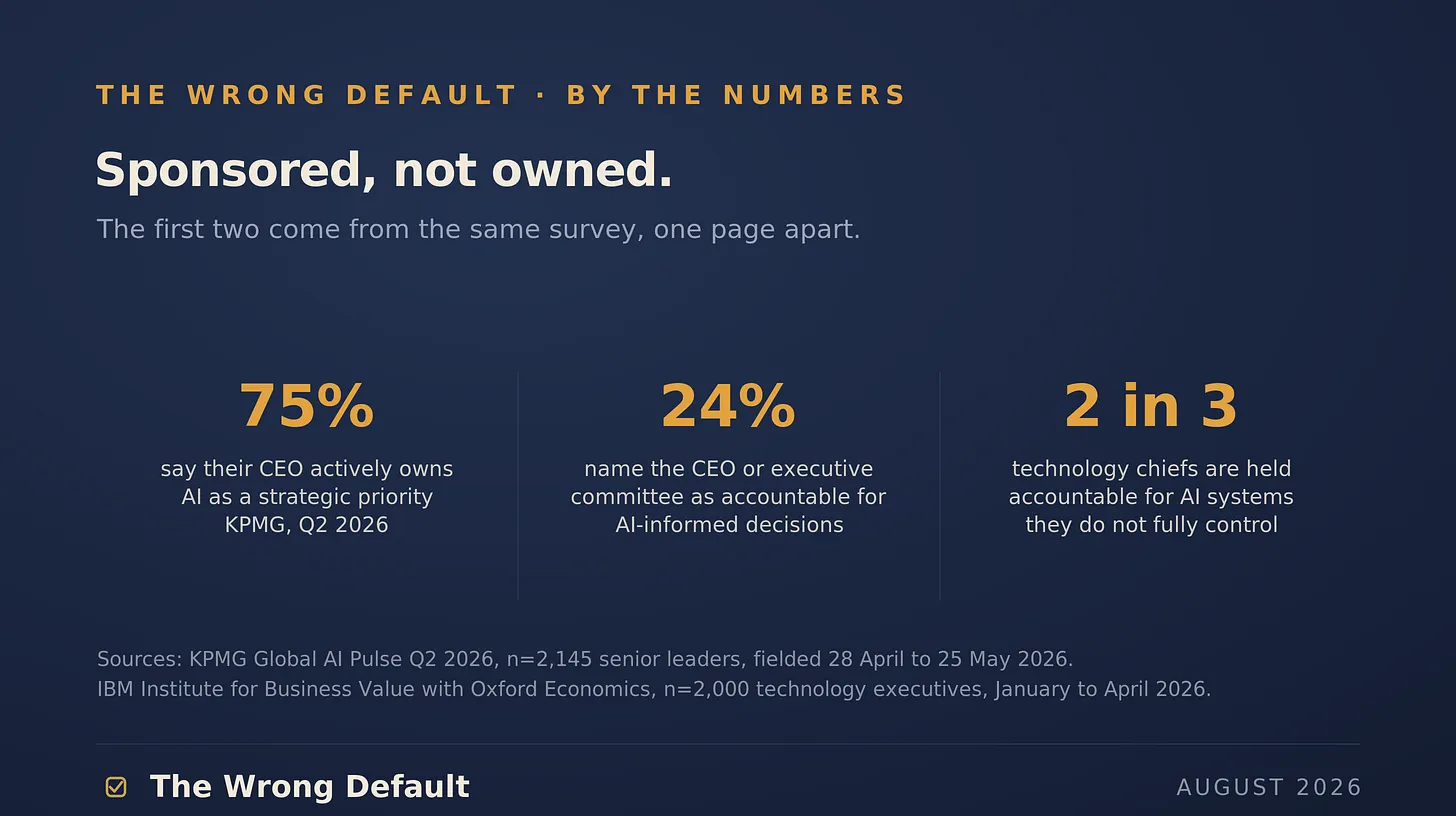
Three quarters say their CEO owns AI. Under a quarter say the CEO or executive committee is accountable. Two thirds of technology chiefs answer for AI they cannot control.
Ask people below the C-suite whether their organization has clear executive ownership of AI decisions and 57 percent say yes. Ask the board and it drops to 53. Ask the C-suite itself, the people who would have to be that owner, and it falls to 34.
That is from Pearl Meyer’s second-quarter survey, 116 respondents across public companies, private companies and nonprofits, fielded in May and June of this year. Overall, fewer than half, 48 percent, said ownership was consistently clear. The gradient is the interesting part. Confidence about who owns AI is highest among the people who will never have to be the answer, and lowest among the people who might.
On Tuesday I argued that naming an owner is the easy half of the job, and that the owner has to be handed something on the first morning or the title is all anyone has. I want to take the other half now. Not what the owner needs. Who the owner should be.
Start with what has already happened, because the naming is largely done. KPMG’s Global AI Pulse for the second quarter, 2,145 senior leaders at organizations above 50 million dollars in revenue across twenty countries, fielded from April 28 to May 25, reports that 75 percent say their CEO actively owns AI as a strategic priority.
BCG’s AI Radar, published in January, found the same thing from the other side of the desk. Seventy-two percent of the 640 chief executives in its sample said they are their organization’s main decision maker on AI, twice the share of the year before. That figure is self-reported, and it should be hold as such. But the direction is not in dispute. Executive sponsorship of AI is close to settled.
Then KPMG asked a different question, and the answer went somewhere else entirely. The question was: who is ultimately accountable for business decisions informed or executed using AI outputs? Twenty-four percent named the CEO or the executive committee. Twenty-nine percent named a specific C-suite executive accountable for AI outcomes. Fifteen percent named the business unit or function leader actually using the system, 13 percent a centralized AI governance or risk committee, 13 percent said accountability was shared across multiple roles. Three percent said it was unclear or not formally defined. Two percent were not sure. One percent answered that their AI systems operate autonomously within approved limits.
KPMG names the distinction itself, in its own foreword, and the credit belongs to them rather than to me: “CEO sponsorship is now widespread, but the data tells a more nuanced story: ownership and accountability are not the same thing.” Three quarters of organizations say the CEO owns AI. Under a quarter say the CEO or the executive committee is accountable for what it decides. Both numbers are true, and the space between them is the whole subject of this piece.
IBM measured that space from the inside. Its Institute for Business Value, working with Oxford Economics, surveyed 2,000 senior executives responsible for IT, technology or AI decisions across 33 geographies and 19 industries between January and April, and published the result on June 8. Two thirds of them report being held accountable for AI systems they do not fully control.
The surrounding numbers explain how that happens without anyone behaving badly. Seventy percent say teams across the business are deploying technology faster than IT can track it. Seventy-seven percent say AI adoption is already outpacing their governance capabilities. Eleven percent believe they are fully ready for the scale of agent deployment they expect within a year. The organizations surveyed averaged 54 AI agent incidents last year, meaning an unintended or harmful occurrence that required a human to correct it, and 17 percent of those were severe enough to take more than four hours to contain.
So the position a great many senior people are now in is this: they hold the accountability, and someone else holds the controls. That is not ownership. Ownership is a bundle of rights over a thing. What is being distributed right now is the liability, and the rights are staying wherever they happened to land. Accountability without control is not ownership, it is exposure, and the org chart cannot tell the difference between the two.
Which means the question has been asked in the wrong currency. “Who should own AI in your company” sounds like a question about titles, and it gets answered with titles: the CIO, a new Chief AI Officer, the CEO, a committee. But a title is a claim about ownership, not a demonstration of it. The demonstration is a control right, and control rights are testable in a way that titles are not.
So test them. The cheapest and bluntest control right anyone has over a system is the ability to turn it off, and that makes it the right one to test first. Call it the Stop Test. Answer three questions, and the real owner is made clear.
First, authority. Who can stop this system? Not which department, and not which committee. A person, by name, who can make the call alone. If stopping requires convening anyone, then during the hours it takes to convene, nobody is the owner and the system is running.
Second, mechanism. Can that person stop it without the vendor’s cooperation? This is where most organizations discover what they actually bought. An AI feature that arrived switched on inside a suite you already licensed does not necessarily come with an off switch you control, and a model embedded three layers down in someone else’s product may not be separable from the product at all. If the answer to “can we stop it” is “we would open a ticket,” the vendor owns the stop and your named executive owns the consequences.
Third, exercise. Has anyone ever actually stopped it? A stop that has never been used is not a capability. It is a belief about a capability. Fire drills exist for exactly this reason, and nobody thinks a fire drill is an insult to the building. Run it once, at a manageable time, on a system that matters, and find out whether the safety you were told exists actually functions.
Someone will object that stopping is a crude test, and that mature governance is about calibrated intervention rather than an off switch. They are completely right, and it is beside the point. The stop is the floor. Every more sophisticated control you use, throttling a system, restricting its scope, forcing a human review step, rolling it back to a prior version, etc., is harder to build and harder to exercise than simply halting the system. An organization that cannot do this simple control does not have those capabilities, whatever its documentation says. The stop is not the goal. It is the test that tells you whether anything above it is real.
None of this happened because anyone was careless. Naming an owner came first because naming an owner is something you can finish in a meeting, and building a stop is three different jobs at once: an engineering job, a contract job, and an authority job, each owned by a different function, none of which can complete it alone. Capability also arrived faster than the control surfaces for it, which is what IBM’s 77 percent figure is measuring. The gap is structural, and it is the ordinary signature of a technology moving faster than the institutions holding it. That does not make it safe to leave open.
It is worth saying plainly that nobody cited here is disinterested, including me. IBM sells AI governance and control tooling, and its study finds that control pays. KPMG sells advisory work on exactly the accountability gap it documented. I run an AI strategy, governance, and control layer advisory, and I am about to tell you that this is worth doing and that control is the advantage. An interested party can still be right, and the underlying surveys are large, methodologically disclosed and published in full, which is more than most of what circulates on this subject. Read them yourself and discount all three of us accordingly.
Now to answer the question at hand. The person who should own AI in your company is whoever can pass all three parts of the Stop Test for the systems that matter most. That is frequently not the CEO, and it is not automatically the CIO either. Which is why the 15 percent in KPMG’s data who pointed to the business unit leader actually using the system may be closer to right than the 24 percent who pointed to the chief executive or the executive committee. The business unit leader is often the only person in the building who can halt a workflow by close of business without asking anyone. That is a smaller kind of authority than a C-suite title, but just as critical.
The case for control is not that a regulator will eventually make you prove it. It is that the organizations which built control in are, by IBM’s own measurement, running 25 percent fewer incidents, deploying sixteen times more agents than the ones governing by hand, spending four times less of their AI budget, and reporting 18 percent higher operating margins. Control is not the tax you pay on adoption. In this data it is the thing that lets you effectively adopt at all, and the reason the constrained organizations are moving faster than the unconstrained ones. That is the part of controlling your AI that the compliance only framing keeps getting backwards.
The name is already on the chart in three quarters of companies. Whether it means anything is decided by one question, and it can be answered this afternoon. Can the named person stop the system by end of day, alone, without the vendor’s help, in a way somebody has tested? If they can, you have an owner. If they cannot, you have a spokesperson, and the difference will only ever be visible on the day it matters.
Fellowship Intelligence runs a free Decision Ownership Check: ten questions, about two minutes, no contact details required to see your result. It returns an AI governance exposure score from 0 to 100 across five areas, including governance gaps and visibility and accountability, along with a tier and a suggested next step. It is a directional self-screen rather than a diagnostic, and it will not tell you whether your stop works. It will tell you whether that is a question worth putting on this quarter's agenda. check.fellowshipintelligence.com.
SOURCES
KPMG International, Global AI Pulse Q2 2026, June 2026 (the 75 percent CEO-ownership figure, the accountability chart, and the “ownership and accountability are not the same thing” foreword). Direct PDF. https://kpmg.com/content/dam/kpmgsites/xx/pdf/2026/06/global-ai-pulse-q2.pdf
KPMG AI Pulse landing page, in case the PDF path changes. https://kpmg.com/xx/en/our-insights/ai-and-technology/ai-pulse.html
IBM, “New IBM Study Finds CIOs and CTOs Face Growing AI Control Gap as Enterprise Deployment Scales,” 8 June 2026 (the two-thirds control gap and every surrounding figure used here). https://newsroom.ibm.com/2026-06-08-new-ibm-study-finds-cios-and-ctos-face-growing-ai-control-gap-as-enterprise-deployment-scales
IBM Institute for Business Value, C-suite study landing page for the full report. https://www.ibm.com/thought-leadership/institute-business-value/en-us/c-suite-study/cxo
Pearl Meyer, Q2 2026 Market Intelligence Leadership Executive Summary, August 2026 (the 34 / 53 / 57 gradient and the 48 percent overall figure). Direct PDF, and the only place the numbers appear. https://pearlmeyer.com/sites/default/files/2026-08/Q2-2026-Market-Intelligence-Leadership-Executive-Summary-August-2026.pdf
Pearl Meyer report landing page. Note that the landing page HTML does not contain the figures. https://pearlmeyer.com/insights-and-research/research-report/AI-execution-puts-executive-confidence-to-the-test
Fortune, “Companies are spending trillions on AI. The C-suite doesn’t know who is in charge of it,” 20 August 2026. Corroboration for the Pearl Meyer figures, not the source for them. https://fortune.com/2026/08/20/companies-spending-ai-ceo-csuite-board/
BCG, “AI Radar 2026: As AI Investments Surge, CEOs Take the Lead,” 15 January 2026 (the 72 percent CEO self-report). https://www.bcg.com/publications/2026/as-ai-investments-surge-ceos-take-the-lead
BCG press release carrying the numeral and the doubling claim. https://www.bcg.com/press/15january2026-as-ai-investments-surge-ceos-take-lead
BCG AI Radar 2026 slideshow, for the instrument wording and the n = 640 CEO base. https://web-assets.bcg.com/73/8e/cc44cbc14a3b81695f8a3de28ff1/ai-radar-2026-web-jan-2026-edit.pdf