Why AI? No, Seriously, Why?
You bought the promise. The work is in the purpose.
When someone asks that in a meeting, it lands as skepticism. So it gets answered as skepticism. Somebody cites a vendor claim. Somebody mentions a study. Somebody points out what a competitor is doing. The decision looks like it has been made, and the room moves on.
But what was decided?
What is actually happening
McKinsey ran a survey between May 4 and June 8 this year. 1,719 people across 97 countries. Eight in ten said AI has improved their productivity.
In the United States the Census Bureau put adoption at about 55% of workers, using AI on the job for at least one of eleven tasks, in a March survey of its Household Trends and Outlook Pulse panel. Among the people who had used it in the last week, 31% said it saved them one to two hours and a quarter said less than an hour. Another 15% saved three to four hours, and 15% more than four. One in ten saved nothing, and 3% said it cost them time.
So it works, and for most people the gain is real and fairly modest. That part is settled.
Here is the number from that same survey that did not make the headlines. The share of respondents saying AI has contributed positively to their organizations’ EBIT is 37%. McKinsey reports it as essentially unchanged from 2025. The share who qualify as high performers, meaning they credit AI with 5% or more of EBIT and say their organization has seen significant value from it, stands at 6%, also unchanged.
Eight in ten people say the tool makes them more productive. The share reporting that it turns into money has not moved in a year.
That gap is not a technology problem.
McKinsey’s own read is that the companies getting real returns did it through organizational change, not by buying tools. Most of the coverage skipped that line.
The trouble with “organizational change” is that a company can agree with it for two years and never do anything.
Why the convention is struggling
Every one of the four biggest professional services firms has published AI-generated errors under its own name.
KPMG published a report called Total Experience: Redefining Excellence in the Age of Agentic AI. Researchers checked its 45 citations. Five held up. One cited a 2019 press release as evidence of agentic AI, which did not exist commercially in 2019. KPMG removed the report and said it was reviewing the circumstances of its publication.
Deloitte delivered a report to the Australian Department of Employment and Workplace Relations under a AU$440,000 contract. It contained fake citations, phantom footnotes, references to work by real academics who never wrote them, and a quote from a Federal Court judgment that the court never wrote. Deloitte partially refunded the contract. The corrected version disclosed that a generative model had been used to fill gaps in the documentation.
EY Canada pulled a cybersecurity report where 16 of 27 citations were broken or did not exist. One of them was a McKinsey “Loyalty Economics Report” putting unredeemed rewards at $200 billion. There is no such report. Researchers traced the fake citation to a blog post six months earlier carrying the identical nonexistent reference, which means it was not invented fresh. It was picked up and passed along.
Researchers found four PwC Middle East reports with fabricated citations. One described a governance framework called Citizen Pulse and presented it as adopted by Denmark, Saudi Arabia, the United States and Australia. They could find no public evidence that any of them use it, and no mention of the framework anywhere outside that report. PwC said it is updating a limited number of supporting citations.
I am not bringing this up to take a shot at anyone. All four got caught and fixed it in public, which is more than most companies do.
I bring it up because these firms have quality controls. They have research standards. They have more AI expertise on staff than most companies have in the whole building. It happened anyway.
If they could not get this right, the problem is not their talent. And it is not their technology. The model did not fail those four firms. There was no step where somebody checked.
Those Census numbers nearly did not make it into this piece. The Census Bureau still lists the story on its own site. The link it publishes for it returns a page not found. The study is real, it went up on August 11, and the agency is about as credible as a source gets.
I did get to read it in the end, but only from a copy the Internet Archive saved on August 27. The agency’s own copy is gone, three weeks after publication, and the archive was refusing to serve that copy earlier the same day I finally got in. Those numbers are real, published by the federal government, and there is no longer a government page that will show them to you.
That is the point. Verification is not only a defense against made-up sources. It is a habit, and the sources you trust most are the ones you are least likely to check.
Yes, it is a tool
That is the usual defense. AI is just a tool.
Fine. It is. That does not settle anything.
A tool is only worth what the person holding it means to do with it. Give the best instrument ever made to someone with no idea what they are trying to accomplish and you get nothing. Give a rough one to someone who knows exactly what they need and you get something you can measure, fix, or walk away from on purpose.
Calling it a tool does not lower the bar. It raises it. It puts the result on you, not the tool.
If it failed, you probably did not buy the wrong thing
If this already happened to you, this part is worth reading closely. A failed AI rollout is usually not the result of a bad purchase. The software mostly did what it said. The problem happened before anybody logged in. Somebody took a business problem, handed it a technology solution, and expected the system to do the rest.
What actually goes wrong
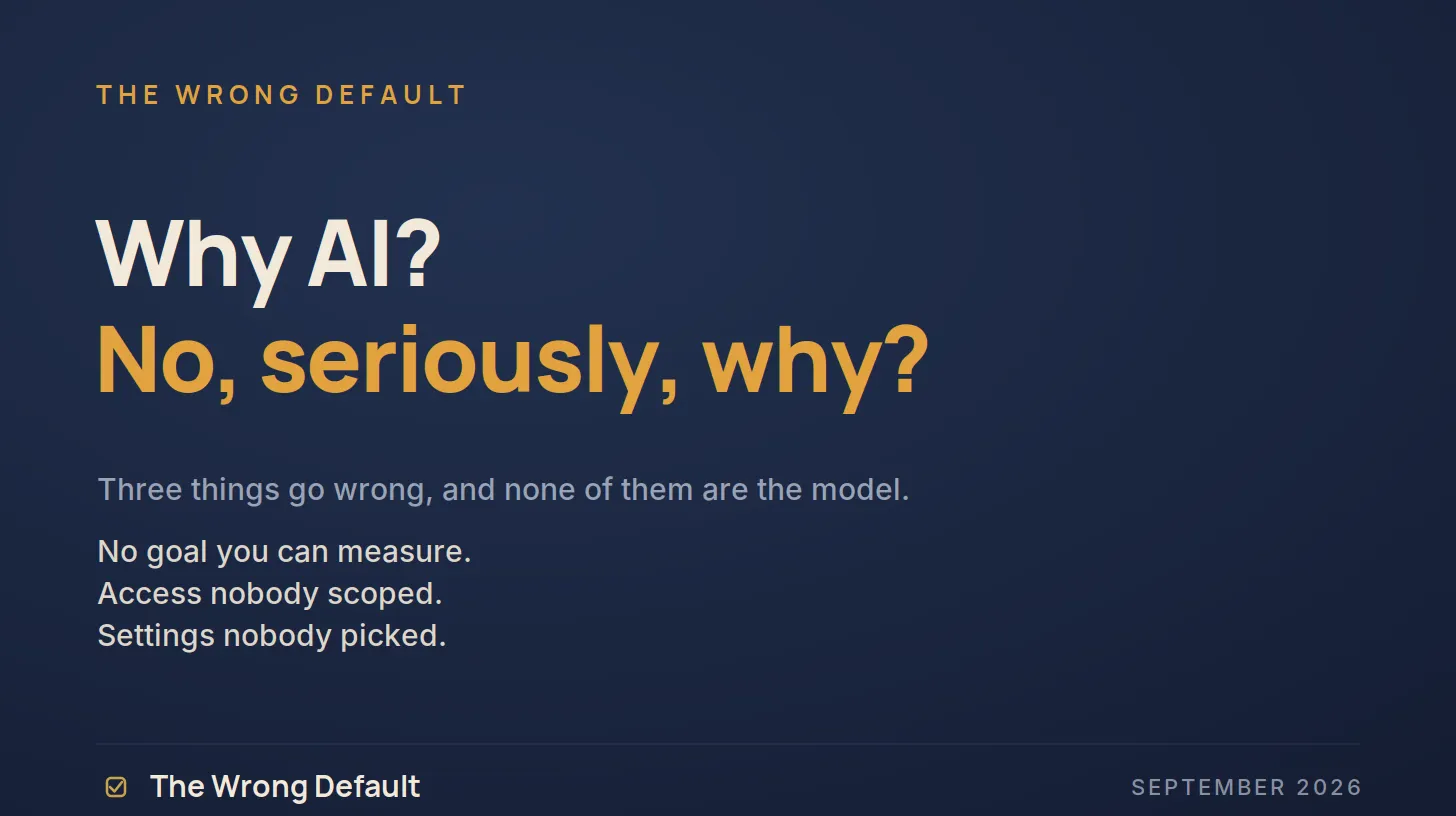
Three things. None of them are related to the model.
Nobody set a goal you could measure: “Improve productivity.” “Reduce expenses.” “Explore AI.” “Do not fall behind.” You cannot pass or fail any of those. Six months in, somebody asks if it worked, and nobody can answer, because nothing was ever written down that would settle it. A pilot without a defined outcome cannot succeed. It can only keep going.
Nobody scoped the access: Not carelessly, and almost never on purpose. These systems ask for access frequently. Even an informed, responsible person reads a reasonable request and approves it. What the system can actually reach, and what it can do once it is in there, is not fully described in each request. That is not a diligence failure on the reviewer. The request just does not give a complete list of every command it will be running once access is granted. And most modern users would not be able to decipher what is being requested in enough time to make a truly informed decision and still maintain the increased productivity they are trying to achieve if they did.
Nobody picked the settings: Features on. Retention set. Sharing enabled. Configured by somebody who has never met you, your clients or your employees. No questions asked or answered before systems are being given access to massive amounts of information. It shows up in your inbox, already switched on, and most companies agree to terms they only read for the first time after something surprises them.
The argument about the wrong thing
Almost all the attention goes to accuracy or security. Did the new model get a better answer, faster? Did it make something up? Did it “break containment?” Can we trust it?
Loud arguments. Easy to have an opinion about. Mostly beside the point.
Picture a system that is right every single time. It never misses. Now point it at no goal you can measure, on access nobody scoped, with settings nobody picked. It produces nothing you can bank, nothing you can defend, nothing you can repeat.
Accuracy and security are about the system. Value is about the organization. Two different problems, and only one of them is yours.
The real mistake
You bought the promise. The work is in the purpose.
The promise is easy to buy. It is in the demo, on the pricing page, in the competitor’s announcement, on the slide with the big number. All it costs you is a signature.
The purpose is harder, because it is not a technology question. What are we trying to change. How will we know if it changed. Who is responsible. What are we willing to let this thing get to, said out loud, in front of people. What would make us shut it off.
No vendor can answer those for you. Not because they are hiding anything. The answers are specific to your business, and your business is the one thing they do not have.
What this takes to fix
Intention. Sit with that for a second.
Every one of these is a decision, not a purchase. Writing down a measurable outcome costs nothing. Scoping access costs nothing. Reading the default settings and deciding whether you agree with them takes an afternoon and is not fun, and it still costs nothing.
So the company with the bigger AI budget has no edge on you here. Most of them have not done it either. Nothing looks broken, and the invoice shows up whether anyone answered the questions or not.
So, why AI?
If you have a real answer, it will probably work for you. The data says it works for most of the people surveyed.
If you do not, no amount of it will help. You will spend the next year arguing about whether the model is any good, and that was never what was going to decide your success.
Where to start. The free Decision Ownership Check asks where the decisions around your AI actually sit and gives you a score at the end. Takes a few minutes. fellowshipintelligence.com/check
SOURCES
McKinsey & Company / QuantumBlack, The State of AI, 2026 survey. Fieldwork 4 May to 8 June 2026, 1,719 participants across 97 nations, 36 percent from organizations above $1B revenue. Source for the eight-in-ten productivity figure, the 37 percent EBIT figure and the “essentially unchanged from 2025” wording, the 6 percent high-performer figure and its two-part definition, and the organizational-change conclusion. https://www.mckinsey.com/capabilities/quantumblack/our-insights/the-state-of-ai
GPTZero, investigation into KPMG, Total Experience: Redefining Excellence in the Age of Agentic AI, October 2025. Source for the 45 citations checked, the five that held up, and the 2019 East Japan Railway press release cited as evidence of agentic AI. https://gptzero.me/news/investigations-kpmg/
City AM, KPMG report on AI found riddled with AI hallucinations. Source for KPMG removing the report and reviewing the circumstances of its publication. GPTZero’s investigation carries no KPMG statement; this is where the response is recorded. https://www.cityam.com/kpmg-report-on-ai-found-riddled-with-ai-hallucinations/
GPTZero, investigation into Ernst & Young, Points of Attack: Uncovering Cyber Threats and Fraud in Loyalty Systems, EY Canada. Source for the fabricated McKinsey “Loyalty Economics Report” and its $200 billion unredeemed-rewards figure, and for the trace back to a Financial IT blog post six months earlier carrying the identical nonexistent reference. https://gptzero.me/investigations/ey
Consulting.ca, EY Canada takes down study after apparent AI hallucinations. Source for the count, 16 of 27 references hallucinated, and for EY Canada removing the study and reviewing why it was published. GPTZero gives the finding qualitatively; the count and the response are here. https://www.consulting.ca/news/5023/ey-canada-takes-down-study-after-apparent-ai-hallucinations
GPTZero, investigation into PwC Middle East, four reports published 2024 to 2026. Source for the Citizen Pulse framework presented as adopted by Denmark, Saudi Arabia, the United States and Australia, and for the finding that the framework appears nowhere outside that report. https://gptzero.me/news/investigations-pwc/
Irish Times, 29 July 2026, PwC published thought leadership reports marred by AI hallucinations. Source for PwC’s only statement, that it is updating a limited number of supporting citations, and for the Financial Times having verified GPTZero’s findings. https://www.irishtimes.com/business/2026/07/29/pwc-published-thought-leadership-reports-marred-by-ai-hallucinations/
Consultancy.uk, The Big Four have now all been caught passing off generative content as thought leadership. Source for the Deloitte contract value of AU$440,000, the Department of Employment and Workplace Relations, the fabricated Federal Court quote, and the partial refund. https://www.consultancy.uk/news/45317/the-big-four-have-now-all-been-caught-passing-off-generative-content-as-thought-leadership
Accounting Times, Deloitte to refund government after using AI in $440k report. Source for the disclosure in the corrected version, an Azure OpenAI GPT-4o based tool chain licensed by the department and hosted on its own tenancy. https://www.accountingtimes.com.au/technology/deloitte-to-refund-government-after-using-ai-in-440k-report
U.S. Census Bureau, “Does Using Artificial Intelligence Save Time at Work?”, 11 August 2026, by Renee Stepler, supervisory survey statistician. Household Trends and Outlook Pulse Survey (HTOPS), reference period March 2026. Source for the 55% of U.S. workers who used AI on the job for at least one of 11 tasks, and for the time-saved distribution among last-week users: 31% saved one to two hours, 25% saved less than an hour, 15% saved three to four hours, 15% saved more than four hours, 10% saved no time, 3% needed additional time. Comparative statements tested at the 90% confidence level. The agency’s own URL for this story returns Page not found. It is still listed on the agency’s index, and the study was read from an Internet Archive capture dated 27 August 2026. The archive holds 128 captures of the URL dated 11 to 27 August, so the figures are checkable at a copy of the publisher’s own page even though they are not checkable at the publisher. https://web.archive.org/web/20260827175143/https://www.census.gov/library/stories/2026/08/ai-use-at-work.html
U.S. Census Bureau, employment stories index. Where the agency still lists the story, and the page from which its own dead link is published. https://www.census.gov/topics/employment/stories.html